
CREON clinical efficacy

Based on FDA-approved label indicated for EPI (exocrine pancreatic insufficiency), CREON is the only PERT shown to significantly improve coefficient of fat and coefficient of nitrogen absorption* in chronic pancreatitis, pancreatectomy, and cystic fibrosis patients.1,2
*CREON significantly improved fat absorption in chronic pancreatitis and pancreatectomy patients, as well as both fat and protein absorption in cystic fibrosis patients.1,2
In clinical trials, CREON demonstrated efficacy in patients with EPI due to chronic pancreatitis, pancreatectomy, and cystic fibrosis.1
Chronic Pancreatitis and Pancreatectomy Pivotal Trial1,3
CREON was studied in patients aged 32 to 75 years old with EPI due to chronic pancreatitis (CP) and pancreatectomy.
CREON achieved statistically significant improvement in CFA from baseline at day 7 of treatment vs placebo (P<0.0001)1,3
CREON achieved statistically significant improvement of fat absorption vs placebo1
Mean CFA after a treatment period of 7 days

CREON was evaluated in a Phase 3, randomized, double-blind, placebo-controlled trial.1,3

At Day 7,
patients on CREON had a
32% improvement in mean CFA from baseline (P<0.0001 vs placebo)1,3
Safety Considerations
- Adverse reactions that occurred in at least 1 chronic pancreatitis or pancreatectomy patient (≥4%) receiving CREON were hyperglycemia, hypoglycemia, abdominal pain, abnormal feces, flatulence, frequent bowel movements, and nasopharyngitis
Fat absorption in patients with diabetes and EPI due to CP or PY5
Post Hoc Analysis: Mean CFA after a treatment period of 7 days5,6

At Day 7,
patients on CREON had a
36% improvement in mean CFA from baseline5
7% increase from baseline with placebo
Safety Considerations
- Adverse reactions that occurred in at least 1 chronic pancreatitis or pancreatectomy patient ( ≥4%) receiving CREON were hyperglycemia, hypoglycemia, abdominal pain, abnormal feces, flatulence, frequent bowel movements, and nasopharyngitis
Study design1,5
This was a post hoc, subgroup analysis of patients with diabetes (type 1 or 2 DM, malnutrition-related diabetes, or type 3c/pancreatogenic diabetes) from a phase 3, double-blind, randomized, placebo-controlled trial in patients with EPI due to CP or PY. The study design and primary endpoint (CA) were consistent with the pivotal trial.
Study limitations5
This subgroup analysis was post hoc and not multiplicity controlled. Data presentations are descriptive in nature. The sample sizes of the diabetes subgroups were small, and caution should be exercised in interpreting these results.
Cystic Fibrosis Pivotal Trial (Patients Aged 12 to 43 Years)1,7
CREON was studied in patients aged 12 to 43 years with EPI due to cystic fibrosis (CF).
Patients taking CREON achieved statistically significant improvement in fat absorption after 5-6 days of treatment
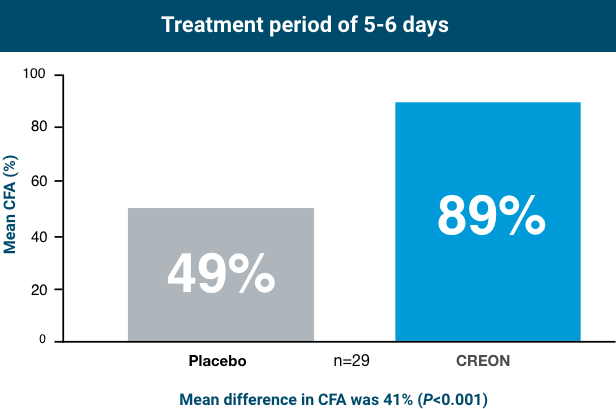
In healthy people, CFA is approximately ≥93%.4
Safety Considerations
- Adverse reactions that occurred in at least 2 cystic fibrosis adult and pediatric patients 7 years of age and older (≥4%) receiving CREON were vomiting, dizziness, and cough
Patients taking CREON achieved statistically significant improvement in protein absorption after 5-6 days of treatment
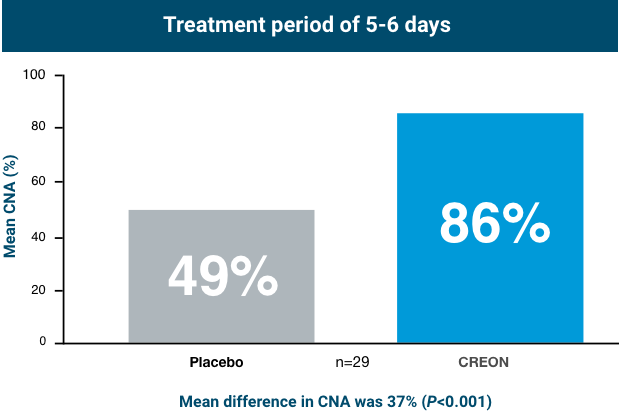
In healthy people, CNA is approximately 88%.4
Safety Considerations
- Adverse reactions that occurred in at least 2 cystic fibrosis adult and pediatric patients 7 years of age and older (≥4%) receiving CREON were vomiting, dizziness, and cough
Cystic Fibrosis Pivotal Trial (Patients Aged 7 to 11 Years)1,8
CREON was studied in pediatric patients aged 7 to 11 years with EPI due to cystic fibrosis (CF).
Patients taking CREON achieved statistically significant improvement in fat absorption after 5-6 days of treatment
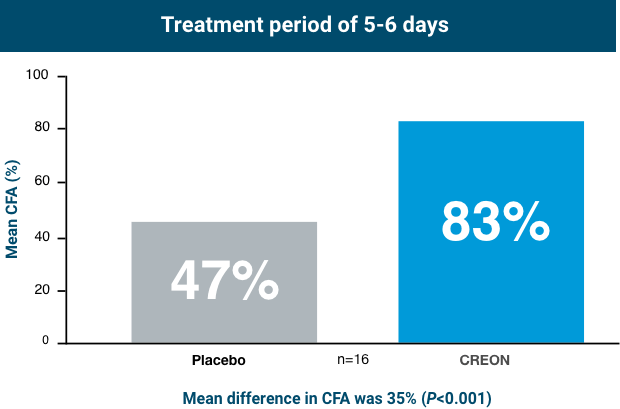
In healthy people, CFA is approximately ≥93%.4
Safety Considerations
- Adverse reactions that occurred in at least 2 cystic fibrosis adult and pediatric patients 7 years of age and older (≥4%) receiving CREON were vomiting, dizziness, and cough
Patients taking CREON achieved statistically significant improvement in protein absorption after 5-6 days of treatment
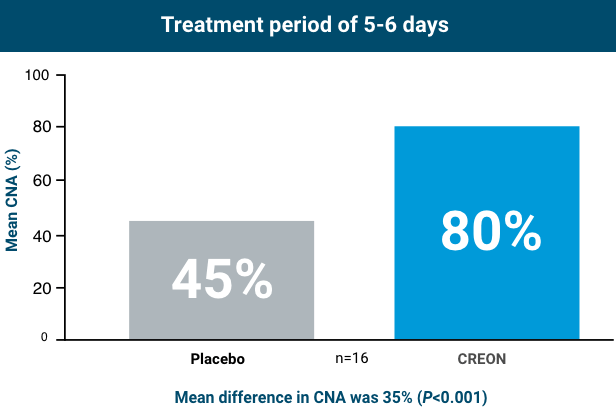
In healthy people, CNA is approximately 88%.4
Safety Considerations
- Adverse reactions that occurred in at least 2 cystic fibrosis adult and pediatric patients 7 years of age and older (≥4%) receiving CREON were vomiting, dizziness, and cough

Based on the clinical studies included in the FDA-approved label, CREON has a well-characterized safety profile.1
CF = cystic fibrosis; CP = chronic pancreatitis; CFA = coefficient of fat absorption; CNA = coefficient of nitrogen absorption; DM = diabetes mellitus; FDA = Food and Drug Administration; PERT = pancreatic enzyme replacement therapy; PY = pancreatectomy.